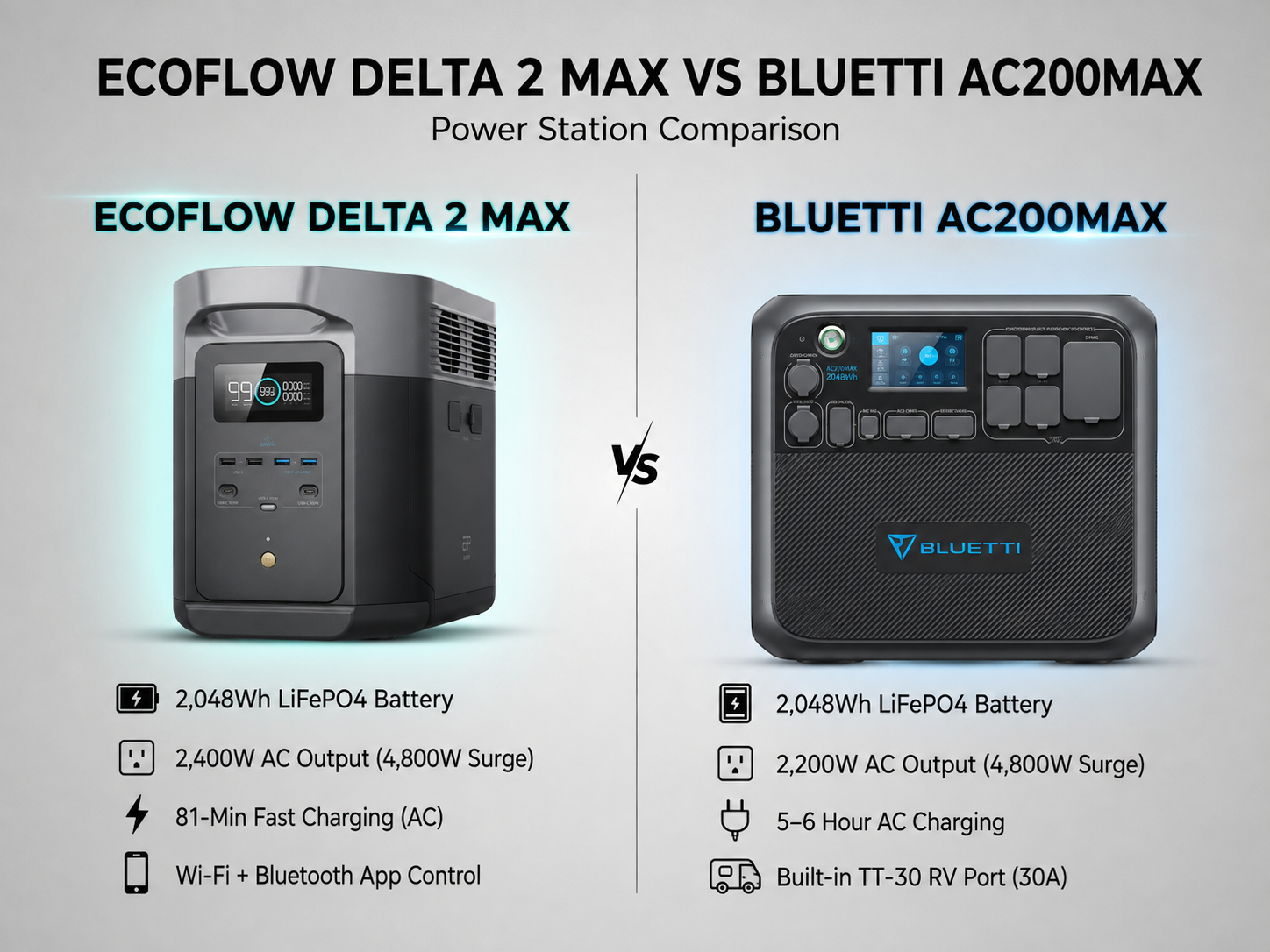
If you have about $1,200 to $1,500 to spend and need a portable power station for your RV, I can almost guarantee your final choice has come down to these two: the EcoFlow Delta 2 Max and the Bluetti AC200MAX.
Table of Contents
🏆 BEST FOR TECH & PORTABILITY
EcoFlow Delta 2 Max
Lightning-fast charging & lightweight
- ✅ 50 lbs (23 kg) weight
- ✅ 81 mins (0-100% charge)
- ❌ 20A Max (Needs adapter)
💸 BEST FOR DIRECT RV PLUG-IN
Bluetti AC200MAX
Built-in RV port & ultimate value
- ✅ 30A TT-30 plug built-in
- ✅ ~$300 cheaper (Great value)
- ❌ 5.5 hrs charge & 62 lbs
The Short Answer
If you want to plug your RV shore power cord directly into the power station without messing with adapters, get the Bluetti AC200MAX. It has a built-in 30A (TT-30) port and is generally cheaper, making it the perfect budget-friendly workhorse.
If you prioritize a lightweight build and extremely fast charging speeds over a native RV plug, the EcoFlow Delta 2 Max is superior. It weighs 12 lbs less, charges in a fraction of the time, and features a much better mobile app.
Real-World Synthesis
If you browse the DIY Solar Forums or Reddit communities, this specific matchup causes fierce debates. Why? Because they both hit the “sweet spot” of 2000Wh, which is enough to run a microwave, a coffee maker, or keep a 12V fridge running all weekend.
The community consensus leans toward the EcoFlow Delta 2 Max for technology. Users rave about how light it is (only 50 lbs) and its ability to charge from 0 to 100% in just over an hour. However, RVers quickly discover its biggest flaw: it does not have a 30A RV plug. You are forced to use a 20A adapter, meaning you cannot pull the full 2400W through a single RV shore cord.
Conversely, the Bluetti AC200MAX is praised as the ultimate boondocking hub. It features that coveted 30A TT-30 port right on the front faceplate. The biggest complaint from AC200MAX owners is the charging speed. Unlike the EcoFlow which has an internal fast-charger, the Bluetti uses a massive external power brick that takes over 5 hours to charge the unit.
Key Specifications Comparison
Here is the head-to-head breakdown of the specs that actually matter when you are off-grid.
| Key Specification | EcoFlow Delta 2 Max | Bluetti AC200MAX |
|---|---|---|
| Battery Capacity | 2,048 Wh (LiFePO4) | 2,048 Wh (LiFePO4) |
| AC Inverter Output | 2,400W (4,800W peak) | 2,200W (4,800W peak) |
| Weight & Portability | 50 lbs (23 kg) – Very Light | 61.9 lbs (28.1 kg) – Heavy |
| AC Wall Charge Time | ~81 Minutes (Internal) | ~5 to 6 hours (External Brick) |
| RV 30A Port (TT-30) | ❌ No (Requires 20A Adapter) | ✅ Yes (Built-in TT-30) |
| App & Ecosystem | Wi-Fi/Bluetooth (Superior) | Bluetooth (Basic) |
| Best For (Winner) | 🏆 Fast Charging & Tech | 💸 Direct RV Plug-in & Value |
Detailed Comparison
Power and the “RV Plug” Issue
Both units provide enough juice to run high-draw appliances like a microwave or a hair dryer. The EcoFlow edges out slightly with a 2400W inverter compared to Bluetti’s 2200W. However, for RVers, the Bluetti AC200MAX wins the usability test.
The AC200MAX has a NEMA TT-30 plug. You take your travel trailer’s shore cord and plug it straight in. The EcoFlow Delta 2 Max only has standard 20A household outlets. To power your rig, you must use a 30A-to-15A “dogbone” adapter. This artificially limits your RV to drawing only 20A (around 2400W total across multiple outlets, but capped per outlet), negating some of its higher power advantage.
Portability and Weight
If you have to lift your power station in and out of a truck bed, pay attention here. The EcoFlow Delta 2 Max is an engineering marvel at just 50 lbs. It is remarkably easy for one person to carry. The Bluetti AC200MAX is a dense 62 lbs. Those extra 12 pounds make a massive difference when you are lifting it at an awkward angle into an RV pass-through storage bay.
Charging Speeds & App Control
This is where EcoFlow justifies its slightly higher price tag. The Delta 2 Max charges from 0 to 100% in a blistering 81 minutes using just a standard AC wall cable (the charger is built inside the unit). You can pull into a campground or a diner, plug it in, and be fully charged while you eat lunch.
The Bluetti relies on a bulky, noisy external power brick that takes over 5 hours to fill the battery. You can buy a second charging brick to speed this up, but it costs extra and means you have to carry around two massive chargers. Additionally, EcoFlow’s Wi-Fi enabled app is years ahead of Bluetti’s basic Bluetooth app in terms of data monitoring and reliability.
Final Verdict
If your main goal is to simply plug your camper’s 30-amp cord into a reliable battery and save some money, buy the Bluetti AC200MAX. It’s a proven workhorse that offers everything a boondocker needs right out of the box.
If you move around a lot, need lightning-fast charging from generators or shore power, and want a unit that won’t throw out your back, spend the extra money on the EcoFlow Delta 2 Max. Just remember to buy a 30A dogbone adapter.
🔥 Related Showdowns: Don’t miss our latest deep-dives: Anker SOLIX F2000 vs EcoFlow Delta 2 Max and the heavyweight battle Jackery Explorer 2000 Plus vs Bluetti AC200MAX.
FAQ
Does the EcoFlow Delta 2 Max have a 30A RV plug?
No, the Delta 2 Max only features standard 20A household outlets. You will need a 30A to 15A/20A dogbone adapter to plug in your RV.
Can the Bluetti AC200MAX charge fast?
Out of the box, it takes about 5.5 hours to charge via the included AC brick. You can cut this down to about 2.5 hours if you purchase a second charging brick.
Which unit has a better battery lifespan?
Both units use LFP (LiFePO4) battery chemistry. They are both rated for 3,000+ charge cycles, meaning they will last for a decade of heavy use.

Hi, I’m Mark Davies, a lifelong RV enthusiast, road-trip planner, and outdoor adventurer. After 15 years of traveling across the country with my wife and two kids in everything from a teardrop trailer to a 35-foot Class A motorhome, I’ve learned exactly what gear survives the road and what falls apart. I created RV Family Enthusiast to help fellow weekend warriors and full-time travelers build the perfect, stress-free mobile setup without wasting money on gimmicks. When I’m not leveling the rig or upgrading my solar bank, I’m here sharing honest, battle-tested reviews.