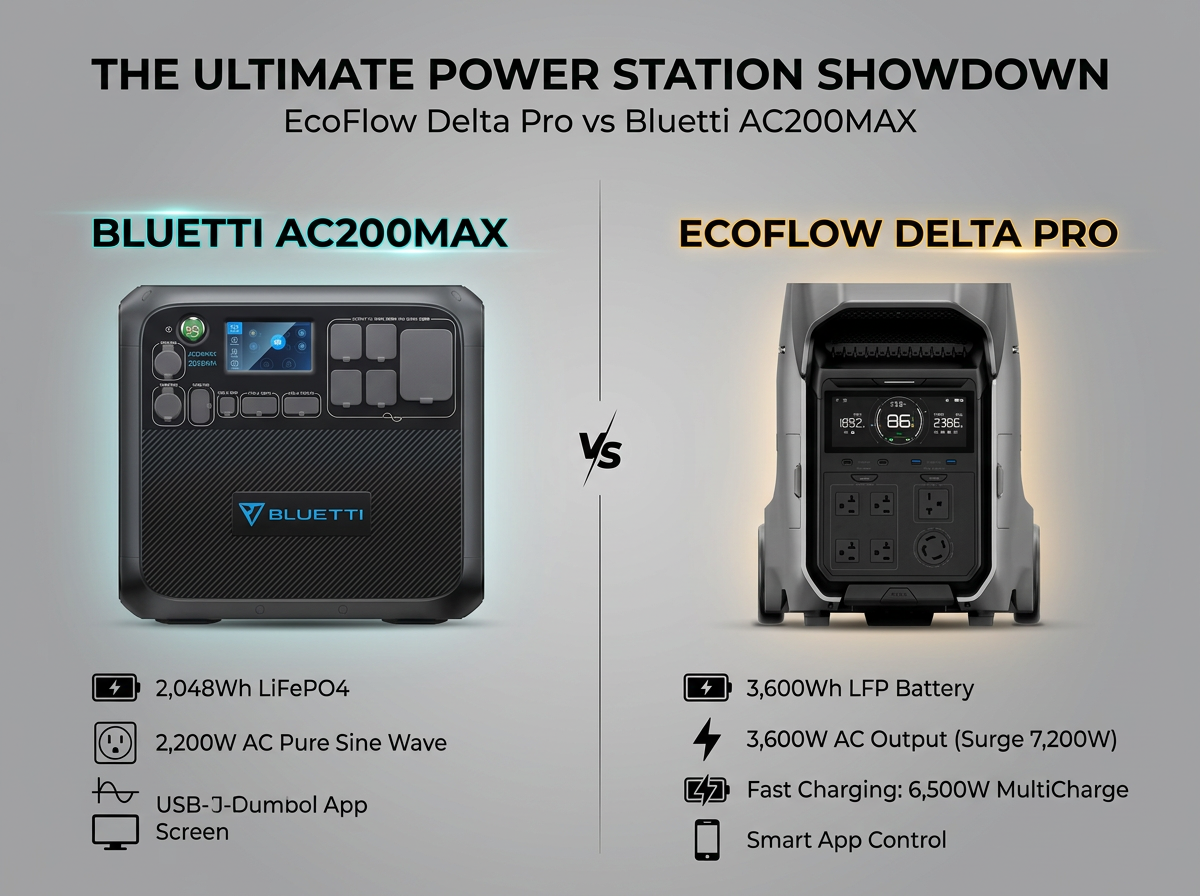
If you’re trying to keep your family’s rig powered off-grid, you’ve probably narrowed it down to two heavyweights: the EcoFlow Delta Pro and the Bluetti AC200MAX. I get asked about these two constantly. After 15 years of upgrading my own rigs and dealing with dead batteries in the middle of nowhere, I know exactly what matters out on the road.
Table of Contents
Both are beasts, but they serve two very different types of campers.
🏆 OVERALL WINNER
EcoFlow Delta Pro
Best for full-time RVers & Heavy Backup
- ✅ 3,600W Output (Runs AC & Fridge)
- ✅ Rapid 2.7-hour charging
- ❌ 99 lbs (Extremely heavy to lift)
💸 BUDGET PICK
Bluetti AC200MAX
Best for weekend warriors & Value
- ✅ Excellent value & LiFePO4 battery
- ✅ Easy to lift (61.9 lbs)
- ❌ App connection can be clunky
The Short Answer
If you are a weekend warrior looking for a reliable, compact unit that won’t break the bank, get the Bluetti AC200MAX. It’s simpler, more portable, and just flat-out works without any unnecessary gimmicks.
If you need a massive powerhouse for heavy home backup, full-time off-grid living, or you love having the best smart app ecosystem and rapid charging speeds, the EcoFlow Delta Pro is your premium upgrade. Just be prepared to lift a much heavier unit.
Real-World Synthesis
When you strip away the marketing hype, what do actual RVers say? Based on feedback from dozens of RV owners on Reddit and my own experience in the campground, the consensus is clear: this is a battle of “Bells and Whistles” versus “Simplicity.”
The EcoFlow Delta Pro is widely praised as the premium option. Users love the advanced app ecosystem and the blazing fast charging speeds. However, it’s a massive piece of equipment—often too heavy to comfortably lug in and out of a storage bay on a regular basis.
On the flip side, the Bluetti AC200MAX is considered the reliable workhorse. It doesn’t have the fancy grid-integration features, but it has a fantastic low self-discharge rate and efficient standby power management. The biggest complaint across the community? The Bluetti app is notoriously clunky and sometimes difficult to connect compared to EcoFlow’s highly polished software.
Key Specifications Comparison
Here is a direct head-to-head breakdown of their technical capabilities based on the most critical specs for RVers.
| Key Specification | EcoFlow Delta Pro | Bluetti AC200MAX |
|---|---|---|
| Battery Capacity | 3,600 Wh | 2,048 Wh (expandable up to 8,192 Wh) |
| AC Inverter Output | 3,600W (7,200W peak) | 2,200W (4,800W peak) |
| Weight & Portability | 99 lbs (45 kg) – Built-in wheels & handle | 61.9 lbs (28.1 kg) – Static side handles |
| AC Wall Charging Speed | ~2.7 hours | ~5 to 6 hours |
| RV & Special Outputs | 30-amp NEMA TT-30 / L5-30 port | 30-amp NEMA TT-30 + Dual wireless phone pads |
| App & Ecosystem | Wi-Fi/Bluetooth (Superior control) | Bluetooth (Standard control) |
| Best For (Winner) | 🏆 Raw Power & Whole-home backup | 💸 Portability & Value (Budget) |
Detailed Comparison
Power and Capability
The EcoFlow Delta Pro is built for heavy lifting. If you want to run multiple appliances simultaneously—think a large fridge, a freezer, and maybe even a 15k BTU air conditioner—it has the raw output and the battery chemistry to handle it. The AC200MAX, with its solid 2,200W inverter, is more than capable of handling basic RV needs like microwaves, coffee makers, and laptops without breaking a sweat, but it taps out earlier than the Delta Pro.
Portability and Build
Portability is a major factor when you’re loading up a travel trailer. The Delta Pro is huge and heavy (99 lbs). It has wheels, but lifting it into a truck bed or a tight RV compartment is a two-person job. The AC200MAX (61.9 lbs) is noticeably more manageable. While not exactly a featherweight, it’s much easier to move around if you need to reposition your solar setup or take it out of the rig.
Ease of Use (The App Experience)
Here’s where the two diverge sharply. EcoFlow has invested heavily in their software. Their app is mature, responsive, and packed with smart features that let you monitor every watt entering and leaving your system. Bluetti’s app, according to long-term testing reports and widespread Reddit feedback, is the system’s weakest link. It can be finicky to connect via Bluetooth and lacks the deep data insights of the EcoFlow. If you just want to push a button and get power, Bluetti is fine. If you want to nerd out on data from your phone, EcoFlow wins easily.
Final Verdict
If you’re outfitting a rig for weekend trips or a few weeks off-grid and want a dependable system that won’t destroy your budget, the Bluetti AC200MAX is the smarter buy. You get 90% of the functionality for significantly less money, as long as you can look past the clunky app.
But if you are living in your RV full-time, running heavy power loads, or you simply demand the best tech and charging speeds available, the EcoFlow Delta Pro justifies its premium price. Just make sure you have a permanent, sturdy spot for it in your bay.
🔥 Related Showdowns: Looking for other options? Check out our battle-tested review of the Jackery Explorer 2000 Plus vs Bluetti AC200MAX, or step down to the 2kWh class in our Anker SOLIX F2000 vs EcoFlow Delta 2 Max showdown.
FAQ
Can the Bluetti AC200MAX run an RV air conditioner?
It can run a smaller 13,500 BTU AC for a short time if it has a soft start installed, but it will drain the battery in under 2 hours. For heavy AC usage, the EcoFlow Delta Pro is required.
Is the EcoFlow Delta Pro too heavy for RV travel?
At 99 lbs, it is very heavy to lift. However, it has built-in wheels and a luggage-style handle, making it easy to roll on flat surfaces. You should plan a permanent spot for it in your RV bay.
Can I leave these power stations plugged in all the time?
Yes, both units have advanced Battery Management Systems (BMS) that prevent overcharging, though occasional discharging is good for battery health calibration.

Hi, I’m Mark Davies, a lifelong RV enthusiast, road-trip planner, and outdoor adventurer. After 15 years of traveling across the country with my wife and two kids in everything from a teardrop trailer to a 35-foot Class A motorhome, I’ve learned exactly what gear survives the road and what falls apart. I created RV Family Enthusiast to help fellow weekend warriors and full-time travelers build the perfect, stress-free mobile setup without wasting money on gimmicks. When I’m not leveling the rig or upgrading my solar bank, I’m here sharing honest, battle-tested reviews.