If there’s one thing I’ve learned after 15 years of hauling my family across the country in a 35-foot motorhome, it’s this: losing power in the middle of a freezing night in the desert will make you question all your life choices. I used to rely on loud, gas-guzzling generators, but a few years ago, I switched to portable solar power stations. Best decision ever.
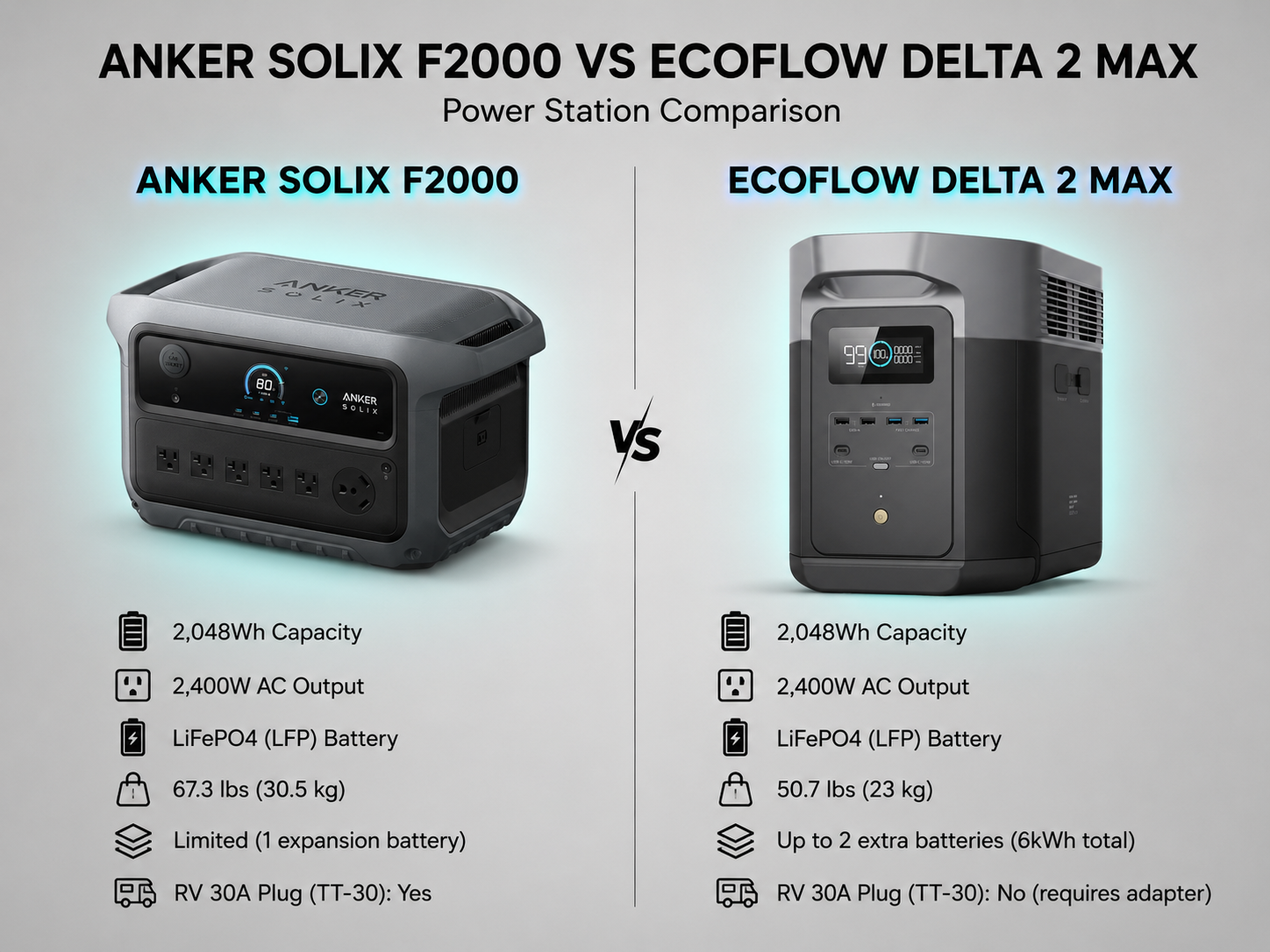
Right now, if you are looking for a heavy-duty 2kWh power station to run your rig’s microwave, keep the fridge cold, and charge the kids’ iPads, you are probably staring at two absolute beasts: the Anker SOLIX F2000 (formerly PowerHouse 767) and the EcoFlow DELTA 2 Max.
Both will cost you a pretty penny, and both promise to be the ultimate off-grid companion. But after digging through hundreds of real-world experiences from the boondocking and vanlife communities, the choice comes down to one brutal question: Are you prioritizing a rugged build, or do you want maximum expandability?
Table of Contents
- The Short Answer: Which One Should You Buy?
- The Real-World Test: What Are Actual RVers Saying?
- Pros and Cons
- Frequently Asked Questions (FAQ)
- Final Verdict
The Short Answer: Which One Should You Buy?
If you don’t have time to read the whole breakdown, here is my verdict:
- Buy the Anker SOLIX F2000 if: You want a “set it and forget it” tank. It’s built like a piece of heavy-duty luggage with wheels and a telescoping handle. It’s incredibly reliable, but it’s heavy (67 lbs).
- Buy the EcoFlow DELTA 2 Max if: You plan on adding more batteries later, you need the absolute fastest AC charging speeds when you only have an hour at a shore power hookup, and you prefer a lighter unit (50 lbs) to move around your rig.
Quick Spec Showdown
| Feature | Anker SOLIX F2000 | EcoFlow DELTA 2 Max |
|---|---|---|
| Capacity | 2048Wh | 2048Wh |
| AC Output | 2400W | 2400W |
| Battery Chemistry | LiFePO4 (LFP) | LiFePO4 (LFP) |
| Weight | 67.3 lbs (30.5 kg) | 50.7 lbs (23 kg) |
| Expandability | Limited (1 expansion battery) | Up to 2 extra batteries (6kWh total) |
| RV 30A Plug (TT-30) | Yes | No (requires adapter) |
The Real-World Test: What Are Actual RVers Saying?
Specs on paper are great, but how do these things survive real life on the road? I spent a lot of time reviewing feedback from the hardcore r/VanLife and r/Generator communities on Reddit. Here is the brutal, unfiltered truth.
1. Portability: The Luggage vs The Box
The Anker SOLIX F2000 is heavy. At 67 pounds, lifting it out of your truck bed is a workout. However, Anker did something brilliant: they added sturdy wheels and a telescoping handle, just like a heavy-duty suitcase. A lot of weekend warriors absolutely love this because you can easily roll it to the picnic table.
The EcoFlow, on the other hand, weighs about 17 pounds less. 17 pounds is a massive difference when you are lifting it awkwardly into an RV storage bay. But it has no wheels. It has two protruding handles on the top, which some users find annoying because it prevents you from stacking gear flat on top of it.
2. The Expandability Factor (EcoFlow Wins)
If there’s one thing full-time RVers eventually want, it’s more power. This is where EcoFlow dominates. The Delta 2 Max allows you to plug in two Smart Extra Batteries, pushing your capacity to a massive 6kWh. If you are boondocking for a week in the shade where your solar panels are useless, that extra capacity is a lifesaver.
The Anker allows only one expansion battery. For many, that’s plenty, but it lacks the modular flexibility of the EcoFlow ecosystem.
3. Customer Service & Reliability: The Elephant in the Room
This is where the community gets highly vocal. Anker has a long history of making reliable tech accessories, and their customer service is generally praised as responsive. Users refer to the F2000 as a “tank” that just runs flawlessly for months off-grid.
EcoFlow makes amazing hardware, but if you dig into Reddit, you will see a recurring complaint: EcoFlow’s customer service can be frustratingly slow. If your unit breaks, getting a replacement can sometimes turn into a lengthy email battle. It’s a risk you have to weigh against their superior technology.
4. The NEMA TT-30 RV Plug (A Big Deal)
Here is a massive pain point for RVers. The Anker SOLIX F2000 comes with a built-in NEMA TT-30 30A RV port. You can take the shore power cord from your travel trailer and plug it directly into the Anker. Boom, your rig is powered.
The EcoFlow Delta 2 Max? No 30A plug. You have to use a 15A-to-30A adapter to plug your rig in, which means you are technically limited by the standard 15A/20A socket on the front. It works, but it’s annoying.
Pros and Cons
Anker SOLIX F2000
- ✅ Built-in wheels and handle for easy rolling
- ✅ Built-in 30A RV plug (Huge for travel trailers)
- ✅ Extremely durable “tank-like” build quality
- ✅ Generally better customer support
- ❌ Very heavy to lift (67+ lbs)
- ❌ Limited to only 1 expansion battery
EcoFlow DELTA 2 Max
- ✅ Lighter and more compact (50 lbs)
- ✅ Amazing ecosystem (can add up to 2 extra batteries)
- ✅ Industry-leading fast AC charging
- ✅ Excellent smartphone app
- ❌ No built-in 30A RV plug
- ❌ Customer service can be hit or miss
🔥 Related Showdowns: Still on the fence? Check out our battle-tested review of the Jackery Explorer 2000 Plus vs Bluetti AC200MAX, or see how the Delta 2 Max stacks up in our EcoFlow Delta 2 Max vs Bluetti AC200MAX showdown!
Frequently Asked Questions (FAQ)
Can the Anker SOLIX F2000 run an RV Air Conditioner?
Yes, but with limitations. Its 2400W output can easily start a standard 13,500 BTU RV air conditioner, especially if you have a soft start installed. However, the 2048Wh capacity means it will only run it for about 1.5 to 2 hours before the battery is completely drained.
Can I plug my RV directly into the EcoFlow DELTA 2 Max?
Not directly. The DELTA 2 Max does not have a 30A TT-30 plug. You will need to purchase a 15A to 30A dogbone adapter to connect your RV’s shore power cord to the standard AC outlets on the EcoFlow.
Final Verdict
If you are a weekend warrior or someone with a small travel trailer, the Anker SOLIX F2000 is my top pick simply because of that built-in 30A RV plug and the suitcase-style wheels. It’s rugged, reliable, and requires zero adapters.
However, if you are building a serious full-time boondocking setup and know you will want to chain multiple batteries together later, or if you constantly find yourself needing to recharge your battery at a public outlet in under an hour, the EcoFlow DELTA 2 Max is the superior piece of technology.
Both are investments, but neither will leave you shivering in the dark.
(Check out the latest prices on Amazon below, and let me know in the comments which one you went with for your rig!)

Hi, I’m Mark Davies, a lifelong RV enthusiast, road-trip planner, and outdoor adventurer. After 15 years of traveling across the country with my wife and two kids in everything from a teardrop trailer to a 35-foot Class A motorhome, I’ve learned exactly what gear survives the road and what falls apart. I created RV Family Enthusiast to help fellow weekend warriors and full-time travelers build the perfect, stress-free mobile setup without wasting money on gimmicks. When I’m not leveling the rig or upgrading my solar bank, I’m here sharing honest, battle-tested reviews.